
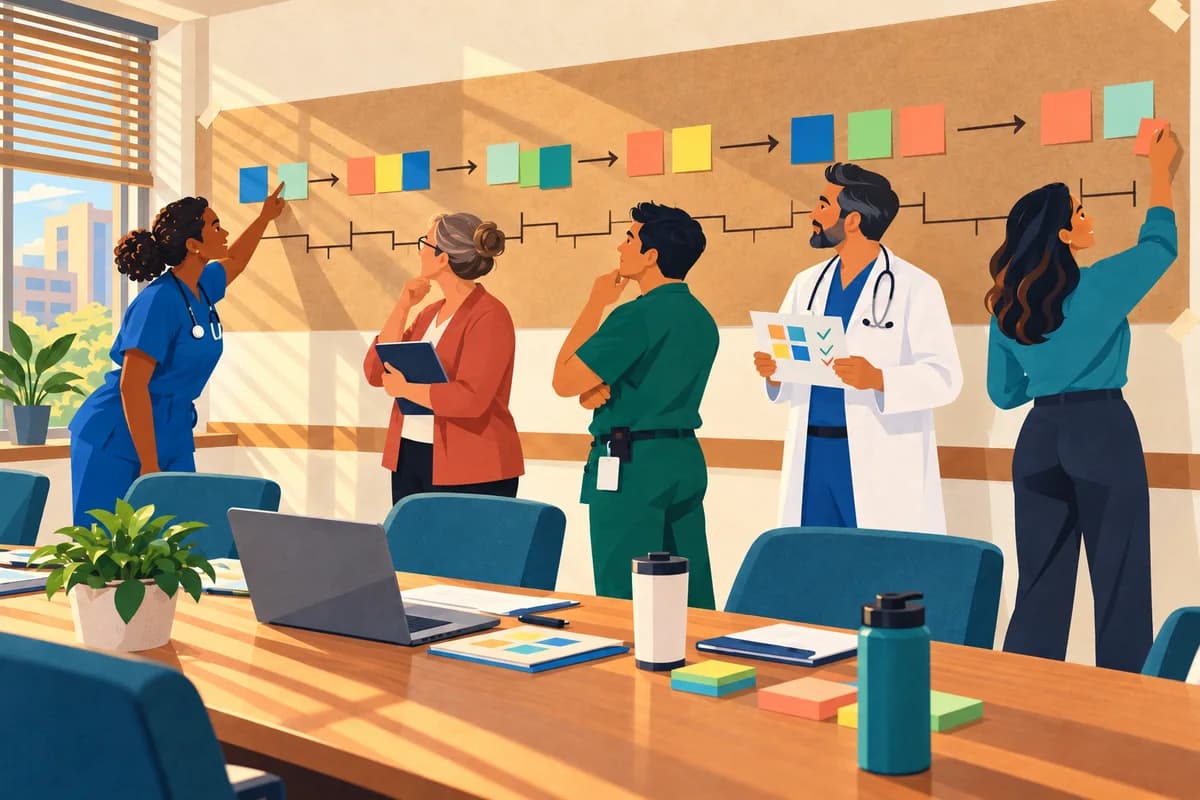
Key takeaways
- Map one patient group with a clear start and end point, and walk the process rather than mapping from memory.
- Record cycle time and wait time at each step. The waits between steps usually hold the biggest gains.
- Design the future state with people from every department the patient passes through.
- Turn each gap into an owned project with a measure, and review progress against the future-state map.
What value stream mapping is
Value stream mapping (VSM) is a lean method for drawing every step, wait and information flow involved in delivering a service from start to finish. It came from Toyota's material and information flow diagrams and was popularized by Mike Rother and John Shook's Learning to See (Lean Enterprise Institute, 1998).
A mapping exercise produces three things: a current-state map of how the process works today, a future-state map of how it should flow, and a plan to close the gap. Its strength is that it shows the whole journey on one map. Most improvement work targets one step, such as lab turnaround or discharge paperwork. VSM shows how the steps connect, and that the biggest delays are often in the handoffs between departments rather than inside any one of them.
What a healthcare value stream map shows
Healthcare maps usually follow a patient group through a process that crosses departments: emergency department arrival to admission or discharge, surgical scheduling to recovery, a discharge order to the patient leaving, or a referral to the first appointment. For each step, the map records:
- Cycle time: how long the work at that step takes.
- Wait time: how long the patient or the work waits before the next step.
- Quality at the step, for example how often the work arrives complete and accurate.
- Who does the work, and the information that triggers each step.

ImprovementFlow
Improvement Projects
Improvement Projects gives each change that comes out of a value stream map its own project, with an owner, plan steps, linked measures and a follow-up review after implementation.
Running a mapping exercise
- 1Choose one patient group and set a clear start and end point.
- 2Name a sponsor who has authority across the departments involved.
- 3Walk the process. Follow several patients, time the steps and the waits, and talk to the staff at each step.
- 4Draw the current state together with people from every department the patient passes through, using real data rather than how the process is supposed to work.
- 5Design a future state that removes waits and unnecessary steps, then list the changes needed to get there.
- 6Turn each change into an owned piece of improvement work, and review progress against the future-state map regularly.
Where value stream work stalls
The map is the easy part. Once the current and future states are drawn and the action plan is written, the change work begins: coordinating across departments, changing long-established habits and holding leaders' attention for months. The action items often end up in a spreadsheet that is stale within weeks, and the future-state map stays on the wall as a picture of what might have been.
How ImprovementFlow supports value stream work
- Process mapping is one of the analysis tools available in Improvement Projects, alongside 5 Whys, fishbone diagrams and FMEA.
- Each change from the future-state plan can become its own project, with an owner, plan steps and due dates.
- Linked metrics, such as wait time or length of stay, show starting, current and goal values on each project.
- Quality directors see active projects across units and sites, so the cross-department work stays visible.