
Key takeaways
- Hospitals no longer need five written environment of care management plans, but the physical environment requirements remain.
- Fire drills are still required quarterly on each shift, and CMS requires two emergency exercises a year.
- Let any staff member report a hazard from a phone in under two minutes.
- Turn every rounding miss into a finding with an owner and a due date.
What changed in 2026, and what didn't
For hospitals and critical access hospitals, The Joint Commission merged its Environment of Care and Life Safety chapters into a single Physical Environment chapter on January 1, 2026, aligned with the CMS physical environment Condition of Participation. Hospitals no longer need five separate written environment of care management plans, and some requirements, including security and utilities, moved into the National Performance Goals. Ambulatory, behavioral health and nursing care center programs keep the Environment of Care chapter name.
The underlying expectations haven't eased. Fire drills are still required quarterly on each shift under the Life Safety Code. The CMS emergency preparedness rule still requires hospitals to run two exercises a year and to analyze and document every drill, tabletop exercise and real event, revising the plan as needed.
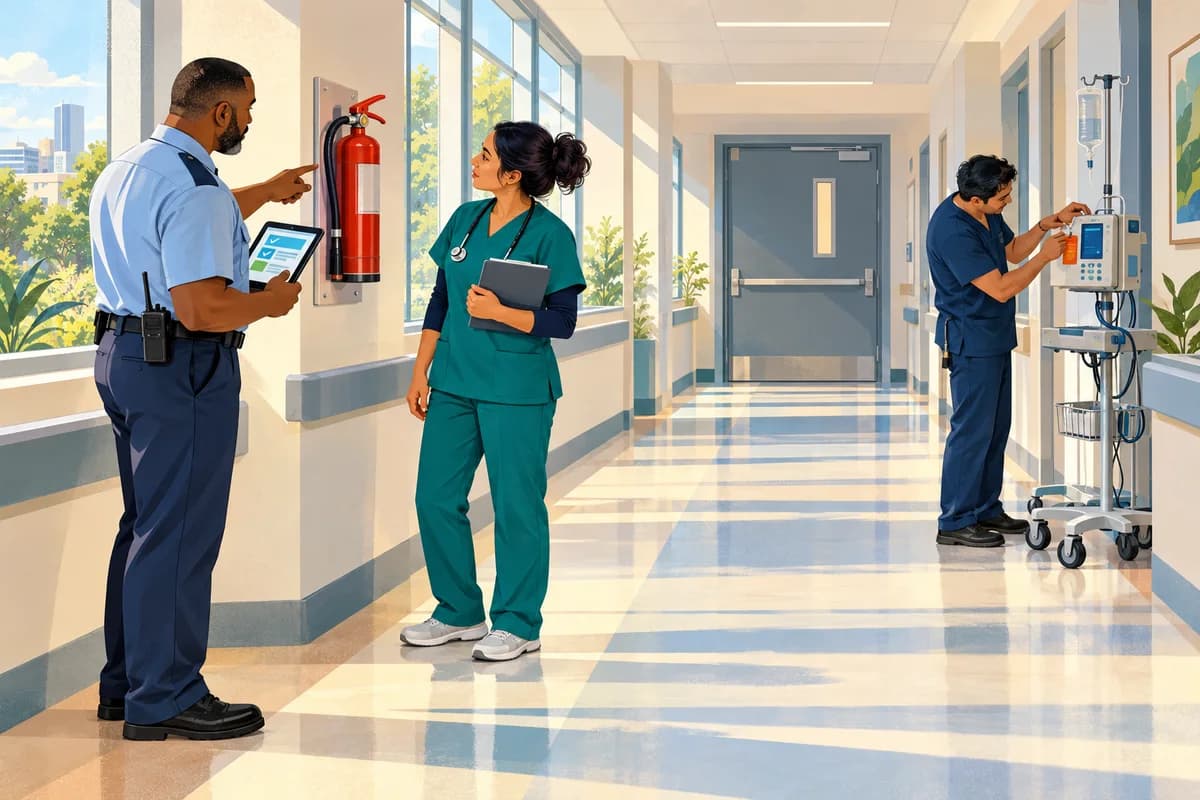
Inspections alone miss a lot. Staff who work in a space every day see the blocked exit, the propped fire door and the failing equipment long before a scheduled round does. A hazard reporting process that any employee can use in a minute or two gives you a far more complete picture of environmental risk.
Sources
- Health Facilities Management, "Joint Commission shares more details about Accreditation 360" (opens in a new tab)
- Health Facilities Management, "Joint Commission aligns fire drill requirements with NFPA" (opens in a new tab)
- 42 CFR 482.15, Condition of participation: Emergency preparedness (opens in a new tab)
What an effective environmental safety program includes
- Environmental rounds with a checklist for each area type, such as general units, ICUs, procedure rooms, storage and mechanical spaces, on a defined schedule
- Hazard reporting open to all staff, not just safety officers
- Tracking of failed and out-of-service equipment, with response timelines and documented resolution
- Fire drill records: the scenario, findings, corrective actions and completion
- Emergency exercise records with an after-action review and improvement plan
- An annual physical environment risk assessment with prioritized improvement projects

ImprovementFlow
Operations Audits
Environmental rounds only reduce risk if what they find gets fixed. Operations Audits runs environment of care rounds on a schedule, records each observation against your standard and tracks every miss to a documented fix.
Your first 90 days
- 1Create rounding checklists for your main area types and round at least monthly, starting with the highest-risk areas
- 2Launch a hazard report that any staff member can complete from a phone in under two minutes; removing barriers is the most important first step
- 3Set a response standard for equipment issues, for example acknowledged within 24 hours and resolved or escalated within 72 hours
- 4Record your next fire drill on a structured form that captures the scenario, findings, staff performance and corrective actions, and use it for every drill after that
- 5Review your most recent survey findings for the physical environment and give each one an owner and a target date
How ImprovementFlow supports this
- Run environmental rounds as scheduled audit programs, with each observation recorded against your standard during the walk
- Turn every miss into a finding with an owner and a due date, closed with evidence of what was done
- See which areas generate repeat findings and which findings are aging, across audits and units
- Let any staff member report a hazard or failing equipment from their phone, routed to facilities or safety for review