
Key takeaways
- Treat 5S as a way to make problems visible, not a cleanup. A shortage or a misplaced item should be obvious the moment it happens.
- Sort and set in order with the staff who use the area, and agree the rules for clinical supplies with infection prevention, pharmacy and supply chain first.
- Time a few supply retrievals before and after. Published projects report large drops in search time, but they are small, single-site studies.
- Sustain is where 5S fails. Check each area against its standard on a schedule, and give every miss an owner.
What 5S is
5S is a lean method for organizing a workplace so that anyone can see at a glance where things belong, what is missing and what is out of place. It comes from Japanese manufacturing, and its best-known source is Hiroyuki Hirano's 5 Pillars of the Visual Workplace (published in Japanese in 1990 and in English in 1995). Each S stands for a Japanese word: seiri, seiton, seiso, seiketsu and shitsuke. Hirano's English edition calls them organization, orderliness, cleanliness, standardized cleanup and discipline. Healthcare teams usually use the five English words below:
- Sort: separate what the area needs from what it doesn't, and remove the rest, such as expired stock, duplicate equipment and supplies nobody on the unit uses.
- Set in order: give every remaining item a marked place, with the most-used items closest to hand, so a float nurse can find them on a first shift.
- Shine: clean the area, and use the cleaning as an inspection for damaged, expired or missing items.
- Standardize: write down what the area should look like and who checks it, so the first three Ss become routine rather than a one-off effort.
- Sustain: build the habit and the checks that keep the standard in place, with leaders looking at the area regularly.
More than a cleanup
The Lean Enterprise Institute describes 5S as a way to create standards that reveal problems, provide the stability that improvement depends on and reduce waste. It also warns against 5S programs that only add rules or focus on how an area looks. A tidy supply room is not the goal. The goal is a room where a shortage, a misplaced item or an overstock is obvious the moment it happens, so someone can deal with it before it delays care.
Some lean practitioners add a sixth S for safety. Toyota traditionally uses only four, dropping "sustain" because its regular audits of standardized work already do that job. Both variations point to the same lesson: 5S lasts when checking the standard is part of normal work.

ImprovementFlow
5S Workplace Organization
ImprovementFlow keeps the fifth S going: a 5S check runs as a recurring audit program with your own instrument and cadence, and every miss becomes a finding with an owner and a due date, closed with evidence.
Tools that make 5S visible
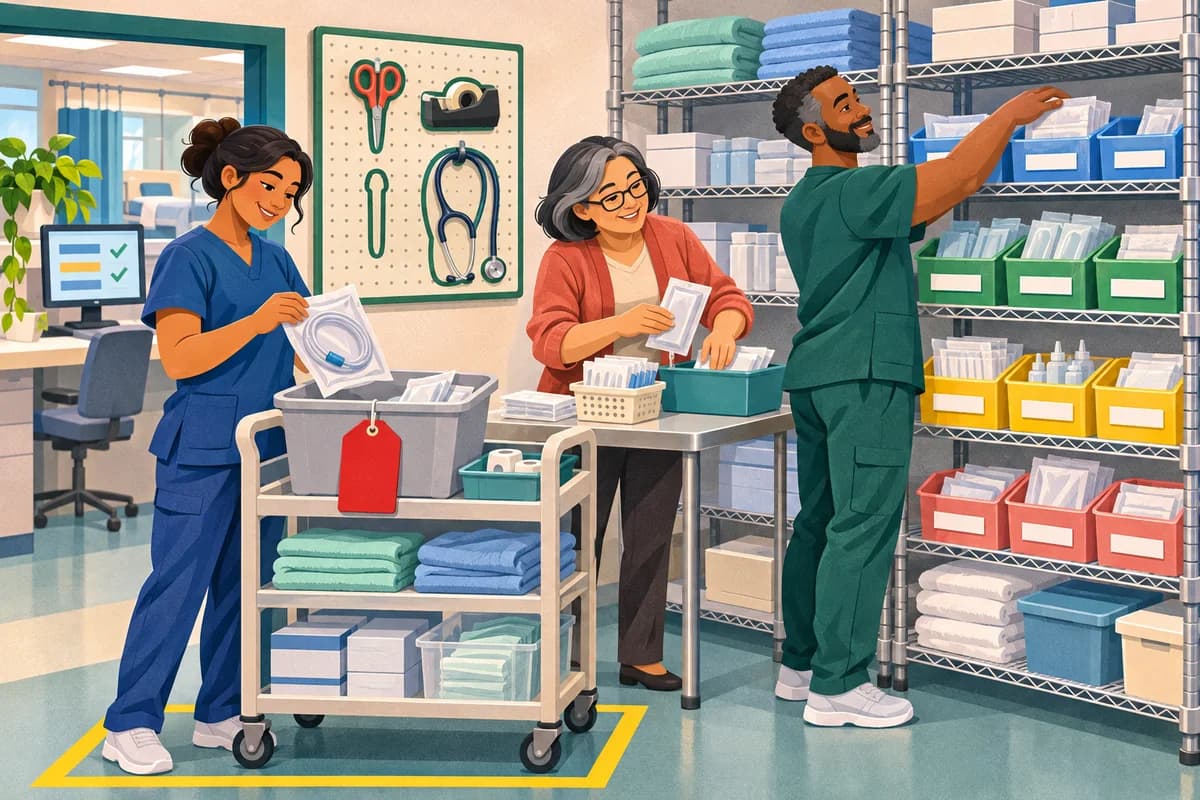
Hirano gives whole chapters to the red-tag strategy and the signboard strategy. Both translate directly to clinical areas, as do shadow boards and floor markings:
- Red tags: any item whose purpose is unclear gets a tag with the date and is moved to a holding area. If nobody claims it within an agreed period, the owner of the area decides whether it is returned, moved elsewhere or removed.
- Signboards and labels: shelves, bins and drawers are labeled with what belongs there, often with a minimum quantity, so anyone can restock or find an item without asking.
- Shadow boards and outlines: shared tools hang on a board with each one's outline drawn behind it, so a missing item shows immediately.
- Floor and wall markings: tape marks where carts and equipment are parked, which also keeps corridors and exits clear.
What the healthcare evidence shows
A 2016 review in Tropical Medicine and Health found 15 empirical studies of 5S in health care, covering primary care facilities and a wide range of hospital areas in Brazil, India, Jordan, Senegal, Sri Lanka, Tanzania, the UK and the USA. The reported changes fell into three areas: safety, efficiency and patient-centeredness. The review notes that 5S is often treated as the starting point for quality improvement, and that the evidence base still needs to grow.
Published US projects tend to measure time spent searching for supplies. At NewYork-Presbyterian/Columbia, medical residents used 5S to design a standardized supply cart, and the time residents took to find an item fell from 50.8 to 30.2 seconds on one unit and from 127 to 28.3 seconds on another, saving each resident about five minutes a day. In a cancer center's CT supply room, reorganizing and labeling supplies with 5S cut the average time to retrieve ten items by 61.7%.
These are small, single-site projects, so treat their numbers as examples rather than predictions. Time a few retrievals in your own area before and after, so you know what changed.
Sources
- Kanamori S, Shibanuma A, Jimba M, "Applicability of the 5S management method for quality improvement in health-care facilities: a review," Tropical Medicine and Health, 2016 (opens in a new tab)
- Yang JX et al., "Improving value-add work and satisfaction in medical residents training: a resident-led quality improvement project employing the lean method to improve hospital supply usage," Postgraduate Medical Journal, 2017 (opens in a new tab)
- Aquino R, Pham TX, Duong PT, "Quality Improvement Report: Improving Retrieval Time for CT Supplies by Using 5S," RadioGraphics, 2024 (opens in a new tab)
Running 5S on one unit
- 1Pick one area that frustrates staff, such as a clean supply room or a procedure cart, and name an owner for it.
- 2Record the starting point: photographs, a count of expired or duplicate items, and how long it takes to find a few common supplies.
- 3Sort with red tags, working with the staff who use the area, and agree how long tagged items will be held before a decision.
- 4Set in order by frequency of use, with labels, minimum quantities and outlines where they help.
- 5Clean the area and fix what the cleaning reveals.
- 6Write a one-page standard for the area: a photograph of how it should look, who checks it and how often.
- 7Check the area against the standard on a regular schedule, share the results at the unit huddle and give each miss an owner.
Where 5S slides back
Most 5S efforts start with an energetic cleanup and then fade. Within a few weeks the labels are out of date, the red-tag area has become another storeroom and the room looks much as it did before. The first three Ss are usually done well. Standardize and sustain are where the effort stops, because nobody owns the area, nobody checks it on a schedule, and problems found during checks have nowhere to go.
A score on its own doesn't help. If a monthly 5S audit produces a percentage but nobody fixes the shelf that keeps overflowing, staff learn that the audit is paperwork. When the same miss keeps recurring, it usually signals a design problem, such as too little storage or a par level that is set wrong, and needs a structural fix rather than another cleanup.
How ImprovementFlow supports 5S
- ImprovementFlow ships a ready-made 5S template. Operations Audits runs the 5S check as a recurring audit program, with the standard for each area and a cadence, across units and facilities.
- Auditors record each item against the standard with a pass or fail. Misses become tracked findings with an owner and a due date, closed with evidence of what was done.
- Trends across audits, units and categories show which areas are slipping, so a finding that keeps coming back gets a structural fix.
- Larger 5S work, such as reorganizing every supply room on a unit, can run as an Improvement Project with plan steps, owners, due dates and linked measures such as retrieval time.